
Call 800 72822 (SCUBA)
Or WhatsApp us on +971507703483


Technical diving isn't just about going deeper. It's about building a life-support system that refuses to fail when you're 50 meters down. You've likely felt the pull toward the deep wrecks off Dubai's coast, yet the complexity of backplate and wing configurations can feel like a barrier. It's natural to worry about spending thousands of dirhams on the wrong gear or feeling unsure about how redundancy actually works in practice.
Master your transition from recreational to technical diving with this comprehensive, expert-curated technical diving equipment list designed for the UAE's deep-water environments. You'll gain a clear understanding of how to prioritize your shopping and why redundancy is your best friend at depth. We'll preview the essential kit from elite brands like Shearwater and Fourth Element, then show you exactly where to get professionally fitted at our facilities in Al Quoz or KhorFakkan. Let's build a setup that matches your ambition and keeps you safe in the silent deep.
Technical diving isn't just "deep recreational diving." It's a complete shift in how you manage risk and interact with the water. When you're exploring the deep wrecks off Dubai's coast, the standard jacket BCD you used during your Open Water course simply won't cut it. A professional technical diving equipment list is built on the foundation of self-sufficiency. It demands gear that is modular, incredibly durable, and capable of handling the high salinity and crushing pressures of the Arabian Gulf.
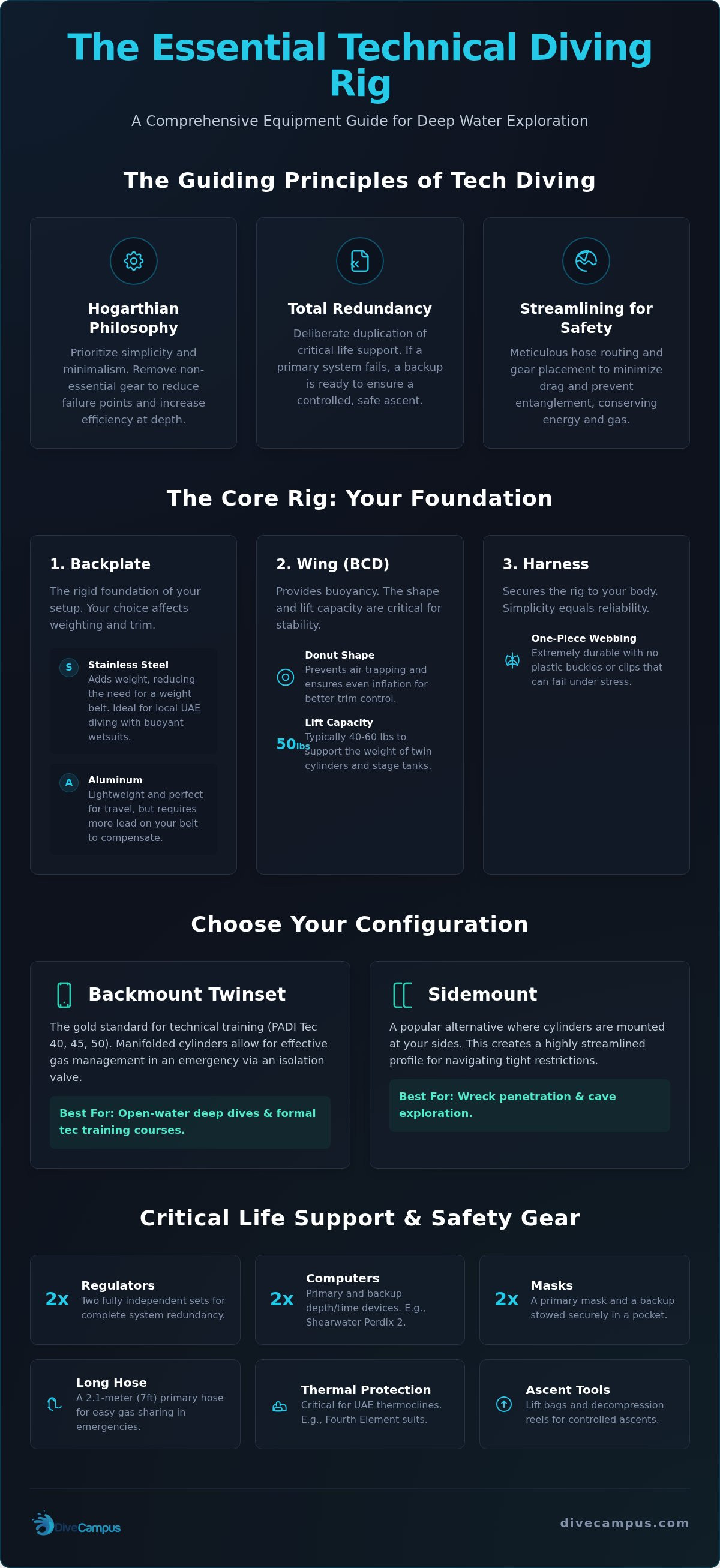
The "Hogarthian" philosophy often dictates this setup. This approach prioritizes simplicity and streamlining. It removes anything that doesn't serve a direct purpose, reducing potential failure points. You aren't just adding more tanks; you're refining your entire configuration to ensure that every movement is efficient and every piece of kit is accessible. This is where the transition begins, moving away from bulky recreational gear toward a system designed for precision.
Safety in technical diving relies on the "Rule of Thirds" for gas management, but that logic extends to your hardware too. Redundancy is the deliberate duplication of critical life-support components to ensure safety in the event of a primary system failure. If a regulator free-flows or a computer dies at 45 meters, you don't head for the surface immediately; you switch to your backup and execute a controlled ascent.
Your technical diving equipment list should always include two independent regulators, two masks, and two depth-monitoring devices. We recommend Shearwater computers, like the Perdix 2, because they allow for seamless switching between gas blends. Having a secondary life-support system isn't a luxury. It's the baseline requirement for entering a world where a direct path to the surface is often blocked by decompression obligations or physical overheads.
In the tight corridors of a wreck or during a complex decompression hang, "danglies" are dangerous. Proper streamlining involves meticulous hose routing and strategic D-ring placement. You want your profile to be as clean as possible to prevent entanglement and reduce drag. Every centimeter of extra hose increases your effort, which leads to higher gas consumption and CO2 buildup.
A streamlined kit doesn't just look professional. it makes you a more capable diver. By minimizing resistance, you move through the water with less exertion, preserving your energy for the actual exploration. This level of organization is what separates a recreational hobbyist from a technical explorer.
The foundation of any serious technical diving equipment list starts with the backplate, wing, and harness. Unlike a recreational jacket BCD, this modular system allows you to customize your buoyancy and trim with surgical precision. In Dubai's varied diving conditions, from the calm waters of KhorFakkan to the deeper wrecks off the coast, having a rig that adapts to your environment is essential. It's the difference between fighting your gear and gliding effortlessly through the water.
Choosing your backplate depends on your ballast needs. Stainless steel plates add significant weight, which is often helpful when diving with the high-performance Fourth Element wetsuits we use locally. Aluminum plates are the lightweight alternative, perfect for international travel but requiring more lead on your belt. Pair this with a simple one-piece webbing harness. Professional divers prefer this "clean" setup because it lacks the plastic failure points found on recreational gear. Forget integrated weight pockets; technical configurations favor weight belts or specialized V-weights for better stability and a lower profile.
This is the gold standard for students entering the PADI Tec 40, 45, or 50 courses. A backmount setup utilizes manifolded twin cylinders, connected by an isolation valve that allows you to manage gas failures effectively. When selecting a wing for twins, look for a "donut" shape. This design allows air to move freely around the cylinders, preventing air trapping and making it easier to dump gas. Ensure your wing has enough lift capacity, typically 40 to 60 lbs, to support the weight of two full cylinders and any additional stage tanks at the start of your dive.
Sidemounting is rapidly gaining popularity for wreck exploration in Dubai. By mounting tanks at your sides rather than on your back, you gain a more streamlined profile and easier access to your valves. This setup requires a specialized harness and a different buoyancy wing, but the flexibility it offers is unmatched in tight spaces. If you're unsure which path to take, you can test both configurations at our Al Quoz facility before committing to a purchase.
The wing selection for sidemount is more compact, focusing on keeping the lift close to your center of gravity. Whether you choose backmount or sidemount, the goal remains the same: a balanced, efficient system that lets you focus on the mission, not your gear. This modularity ensures your kit grows with your skills as you move deeper into the world of technical exploration.
Reliability is the only metric that matters when you're breathing at 50 meters. Your technical diving equipment list must prioritize high-performance regulators designed for extreme conditions. Unlike standard recreational sets, technical first stages are built to handle high gas flows and complex hose configurations. You'll need a primary regulator on a 2.1-meter "long hose" for efficient gas sharing in tight wreck spaces, while your backup sits right under your chin on a dedicated necklace for immediate access.
Precision extends to how you monitor your remaining gas. Technical divers skip bulky consoles and integrated air transmitters. We prefer simple, analog brass pressure gauges (SPGs) clipped to the waist D-ring. These are far more durable in the high-salinity waters of the UAE and offer a clear, fail-safe reading. For decompression stages, your regulators must be oxygen-clean. Using standard recreational regulators for high-concentration oxygen is a safety risk that some guides overlook, but it's a non-negotiable requirement for any PADI Tec course.
Tracking your decompression profile requires more than a basic algorithm. We recommend the Shearwater Perdix 2 or the Teric for their unmatched reliability and crystal-clear displays. These units utilize the Buhlmann ZHL-16C algorithm with Gradient Factors, allowing you to customize your safety margins for local Dubai dives. Always carry a backup computer or a dedicated bottom timer. If your primary device fails, having a second Shearwater on your other wrist ensures you can complete your decompression schedule safely and accurately.
Switching to a decompression gas is a high-stakes moment. To prevent mistakes, every stage tank must be clearly labeled and color-coded. Use high-visibility stickers to mark your "MOD" (Maximum Operating Depth) on both sides of the cylinder. Your stage regulators should be configured with shorter hoses to keep your profile streamlined and prevent entanglement. By keeping your backup regulator secured on a silicone necklace, you ensure it's always exactly where you need it if your primary gas supply is interrupted. This level of organization turns a complex dive into a manageable, professional operation.
Technical diving isn't just about the depth; it's about the duration. While a recreational diver might spend 40 minutes in the water, a technical diver often doubles that. Long decompression stops mean you're stationary in the water column for extended periods. Even in the Arabian Gulf, your body loses heat 25 times faster in water than in air. This makes advanced thermal protection a critical entry on your technical diving equipment list.
Don't let the 33°C surface temperature in Dubai fool you. Once you drop past 20 meters, especially in KhorFakkan, you'll often hit a sharp thermocline where the temperature can plummet to 22°C. Sitting in 22°C water for a 30-minute decompression hang without adequate protection isn't just uncomfortable; it's a safety hazard. Cold impacts your circulation and can affect how efficiently your body off-gasses nitrogen during those vital stops.
We rely on Fourth Element for their superior thermal engineering and commitment to performance. The Proteus II 5mm wetsuit is the local all-rounder for technical exploration. It features glideskin neck seals and an internal lining that minimizes water movement to keep you warmer for longer. For winter months or deeper dives, adding a hooded vest provides essential core warmth without sacrificing the mobility you need to reach your valves. These suits use sustainable materials, proving that high excellence doesn't have to come at an environmental cost.
It might seem counterintuitive, but many serious technical divers in the UAE choose drysuits year-round. A drysuit offers the ultimate thermal control and serves as a secondary buoyancy device if your wing fails. Managing buoyancy with a drysuit requires practice. You must balance the air in your suit with the lift in your wing to avoid the dreaded "floaty feet" scenario. When paired with light moisture-wicking undergarments, a drysuit keeps you comfortable during long-duration dives at 40m+ where the cold eventually seeps in.
Ready to upgrade your exposure kit for the deep? Explore our professional range of Fourth Element Wetsuits at our Dubai or KhorFakkan showrooms.
Technical diving is won or lost in the details. Your technical diving equipment list isn't complete until you've addressed the accessories that manage emergencies and navigation. In the deep wrecks of Dubai, these tools are your primary defense against entanglement and loss of orientation. You aren't just carrying extra gear; you're carrying solutions for scenarios where a simple ascent isn't an option.
Surface Marker Buoys (SMBs) in technical diving are often larger and more robust than recreational versions. We frequently use "lift bags" that provide significant upward force, serving as a stable platform during long decompression hangs. Pair these with a primary reel for exploration and multiple finger spools for deco deployments. For lighting, a primary canister light offers the long burn time required for deep penetrations, but you must also carry at least two high-output backup torches. If your primary light fails in a wreck, those backups are your only way out.
Cutting tools are equally vital. Don't rely on a single knife. Technical divers carry at least two independent tools, such as trauma shears for cutting through fishing line and a small, sharp harness knife for thicker ropes. These should be mounted where they can be reached by either hand, ensuring you can self-rescue even if one arm is restricted.
Carry a backup mask in your Fourth Element tech shorts or a dedicated thigh pocket. If your primary mask strap snaps at 45 meters, you need to be able to clear and swap masks without losing your buoyancy. Navigation at depth requires a technical compass with high-tilt tolerance, allowing for accurate readings even if your wrist isn't perfectly level. Finally, use wet-notes or a wrist slate to record your decompression plan. Relying solely on your computer's memory is a risk; having your run times and gas switches written down ensures you stay on track regardless of electronics.
Investing in technical gear is a significant step that requires expert guidance. You shouldn't buy a backplate or a wing off a shelf without a professional fitting. At DiveCampus, our instructors act as elite mentors to ensure your harness is adjusted perfectly to your body and your hose routing is streamlined for maximum efficiency. We offer specialized "Tec Gear Bundles" for students enrolled in our PADI Tec 40, 45, and 50 programs, featuring the same high-performance brands we use in our own rental fleet.
Ready to build your ultimate rig? Visit our Al Quoz concept store to get professionally fitted by our technical instructors and ensure your kit is mission-ready for your next deep-water adventure.
Transitioning to technical diving is a transformative journey that demands more than just extra tanks. It requires a mindset focused on precision and a technical diving equipment list built for absolute reliability. You've learned how a streamlined backplate and wing system provides the foundation for perfect trim, while redundant life support from brands like Shearwater ensures you're always in control during complex decompression schedules. Managing the sharp thermoclines of the UAE requires specialized thermal protection, making Fourth Element gear an essential part of your kit for those long, silent hangs.
Don't leave your safety to chance with unverified gear or poor fitment. As an official Shearwater and Fourth Element dealer with PADI 5 Star IDC expertise, we provide the elite mentorship you need to select and configure your rig. Our instructors offer expert technical fitting in Dubai and KhorFakkan to ensure every hose and D-ring is exactly where it belongs. Explore the Technical Diving Gear Collection at DiveCampus today and step into the deep with total confidence. The wrecks are waiting, and you're finally ready to see them properly.
You don't necessarily have to purchase a full technical diving equipment list immediately. While some of your recreational gear like fins or masks might cross over, technical courses require specialized setups. We recommend using our rental fleet at DiveCampus during your PADI Tec 40 training. This allows you to test different backplates and wings before investing in your own high-end kit. It's a practical way to ensure you buy once and buy right.
A backplate and wing system offers superior stability and modularity compared to a standard jacket BCD. It places the buoyancy behind you, promoting a horizontal trim that is essential when carrying multiple cylinders. The stainless steel or aluminum plate provides a rigid platform that won't shift during deep dives. Because it lacks plastic buckles and integrated pockets, it's significantly more durable and easier to repair in the field.
Shearwater models like the Perdix 2 and Teric are widely considered the gold standard in Dubai. These computers offer the Buhlmann ZHL-16C algorithm, which is critical for managing the complex decompression schedules required for deep wreck diving. Their high-resolution displays remain legible even in the silty conditions sometimes found on the East Coast. Carrying a Shearwater as your primary device ensures you have the most reliable decompression tracking available today.
Standard recreational regulators often lack the performance or configuration required for technical depths. Your technical diving equipment list must include regulators that can handle high gas flows and are O2-clean for decompression stages. Technical sets also require specific hose lengths, such as the 2.1-meter primary hose. While some high-end recreational first stages are compatible, they usually need professional re-servicing and reconfiguration at our Al Quoz facility to meet safety standards.
The 2.1-meter long hose is a safety requirement for air sharing in restricted spaces like wrecks. If your teammate runs out of gas inside a narrow corridor, a standard short hose would force you into a dangerous, cramped position. The long hose allows you to swim in a single-file line while sharing gas, ensuring a controlled exit. It's a simple piece of equipment that provides a massive safety margin in high-stakes environments.
Both configurations have their place in the UAE. Backmount twinsets are the traditional choice for PADI Tec courses and provide a stable, familiar platform for deep open-water dives. Sidemount is becoming the preferred option for technical wreck exploration because it offers a lower profile and easier valve access in tight spaces. We suggest trying both setups in our Al Quoz training tank to see which matches your specific diving goals.
Long-duration technical dives in Dubai require more thermal protection than you might expect. Even if the surface is warm, you'll likely encounter cold thermoclines at depth. We recommend a 5mm Fourth Element Proteus II wetsuit paired with a hooded vest for most year-round technical dives. For dives exceeding 60 minutes or during the winter months, many local divers switch to a drysuit to ensure they stay warm during long decompression hangs.
The cost of a technical setup varies based on the brands and configurations you choose. Instead of focusing on a single price, we recommend looking at the value of "Tec Gear Bundles" at DiveCampus. Investing in premium brands like Shearwater and Fourth Element ensures your equipment lasts for years of deep-sea exploration. Visit our concept store in Dubai to discuss your budget and get a personalized quote for a mission-ready kit.

Leave a comment